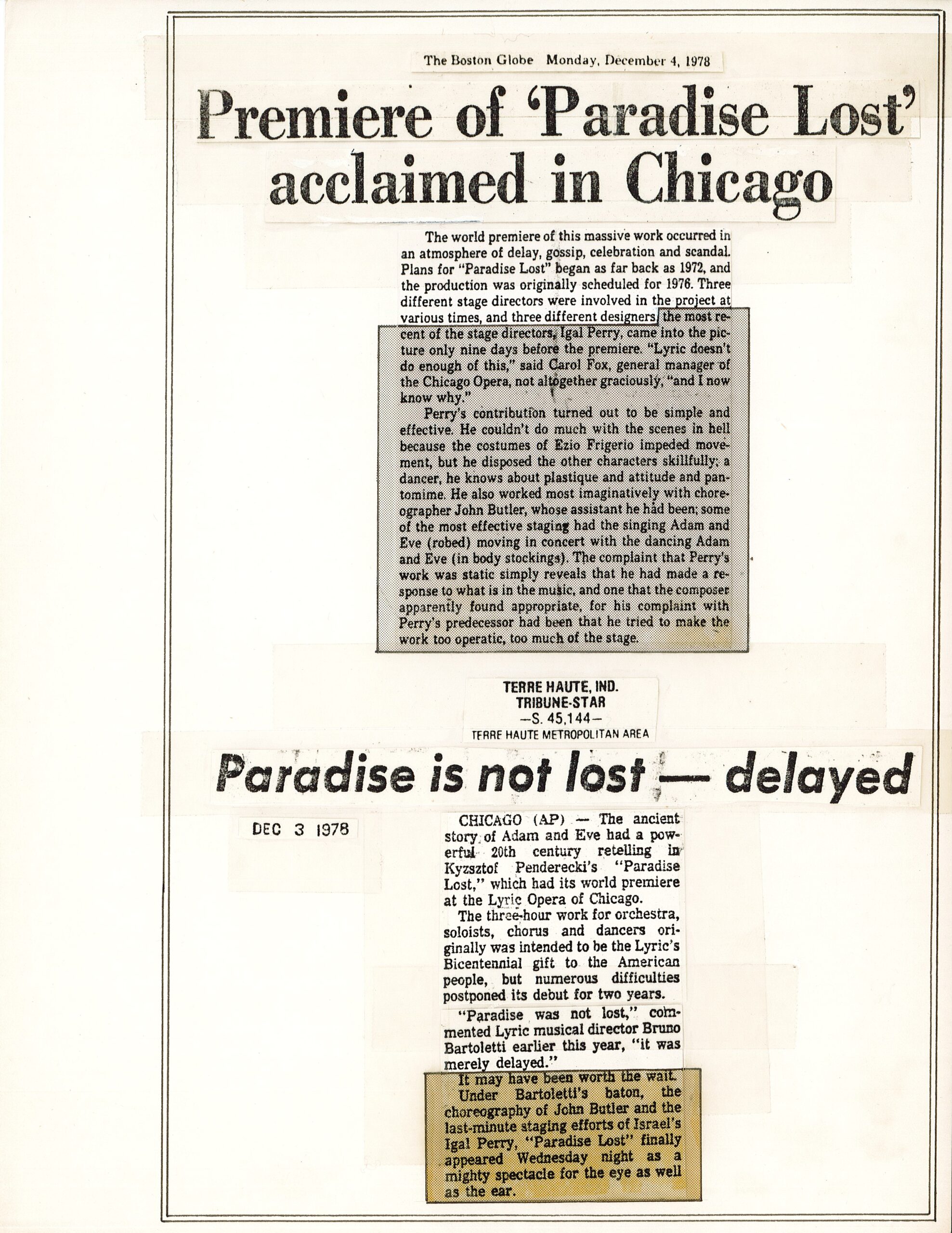
1978 – The Lyric Opera in Chicago, in collaboration with La Scala Opera in Milan was producing the world premiere of Paradise Lost, a new opera by Polish composer Krzysztof Penderecki. John Butler was invited as a choreographer, and I joined him as his assistant. The production was almost all set, but Mr. Penderecki did not approve of the direction the production had taken. He instructed that the opera be presented as an oratorio – minimal staging and more focus on the singing and the music, but evidently the opera was staged in a different manner. 10 days before the premiere the production was halted, and a new production was to take place. At that point, with a recommendation from John Butler, I was called into the conference room where a meeting was held to resolve the situation. I did not know what the meeting was about and thought there was going to be a production meeting to coordinate lighting, technical issues and final plans for the opening night. At the very opening of the meeting, I was startled by a question from Artistic Director Carol Fox, directed at me like a sharp dart: Do you think you can direct this opera? I was so overwhelmed by the inherent implication of directing an opera on one the world’s largest and most significant stages, but quickly answered “Yes”. I knew I could but did not consider the fact that I literally had only 10 days to turn the world upside down. Maria Tallchief (formerly Mr. Balanchine’s lead dancer – and wife), who at the time directed the Chicago City Ballet (participating in the production), turned to me and quietly uttered: “You have read the libretto, of course…”, and I quietly answered: “…Of course”. And the decision was made. I was to re-stage the opera. I had only one request – to get a recording of the opera…
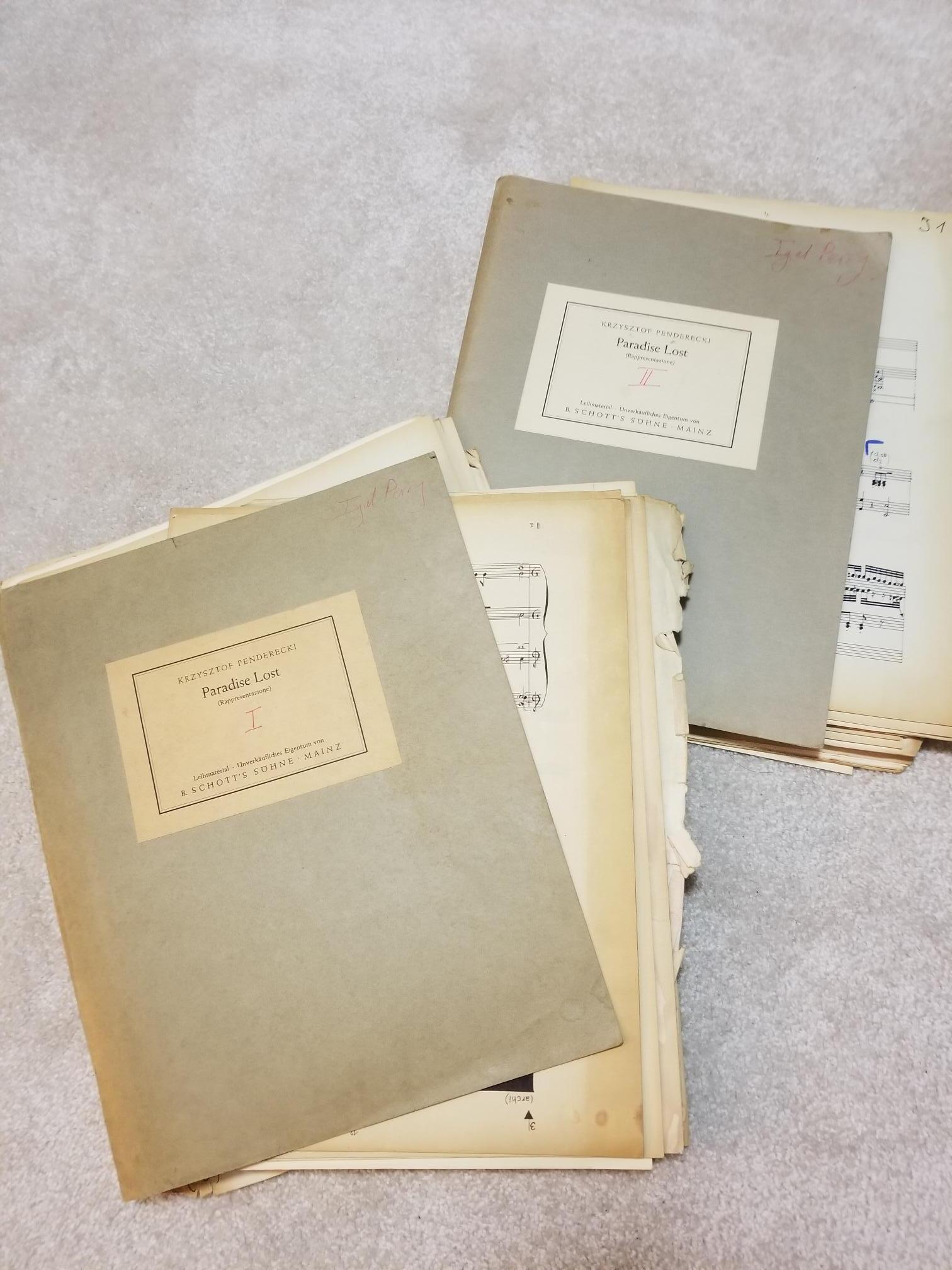
As a choreographer I was very comfortable with dealing with music I was familiar with, and not just with using a written score – which by the way, a piano rendition of it was 3 inched thick! An orchestra recording session was immediately scheduled for the following morning. I came to the stage to be present in the recording and there was a big armchair placed at the front of the stage, facing the orchestra, which was placed on the stage in a strategic formation for the recording. The orchestra director motioned towards the chair to indicate that the seat was there for me and said: “Maestro!”. I have never been addressed as such, and here I was completely immersed in the world of Opera! I felt humbled and yet elated, and mostly so ready to embark on a once in a lifetime adventure. I hardly slept for 10 days, preparing all night, and staging all day. And the premier took place as planned, to critical acclaim (we were all nervous about that…) and with an invitation to La Scala for the re-staging of the opera there… I went in as an assistant choreographer, I came out as an opera director, who would have thought?
1979 – Paradise Lost (La Scala)
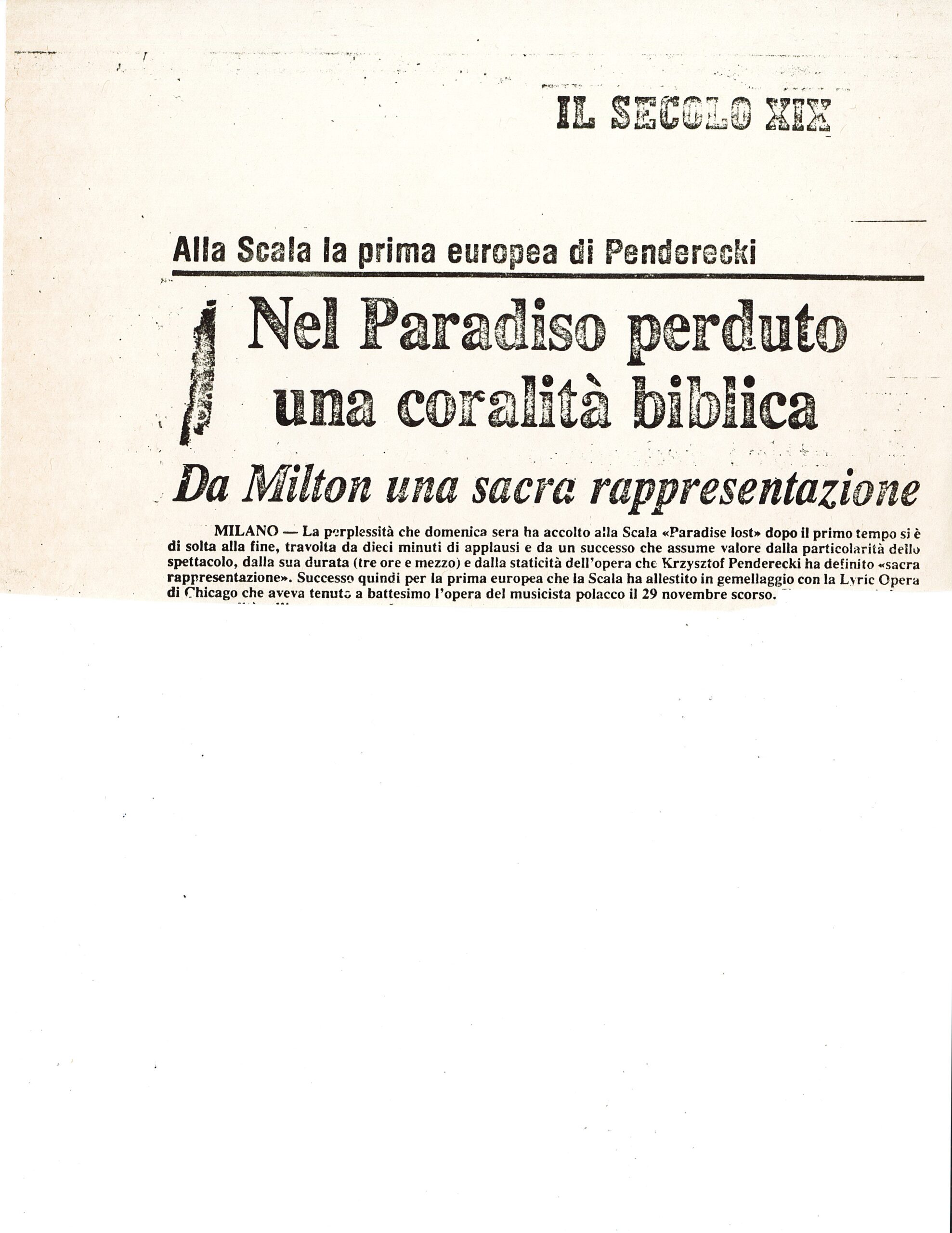
Following the successful presentation of Paradise Lost in Chicago, the opera was to be reproduced at Teatro alla Scala in Milan. I was now officially invited as Director, to stage the opera. Imagine my excitement, well entangled in a web of trepidation and sleepless nights…
My task in Milan was 3-fold: direct the whole production, stage John Butler’s choreography, and be on call to dance if needed. I spoke no word of Italian, but that did not worry me. For starters, I had an interpreter glued to my side 24/7. And being the language lover that I am, I opened my ears to every word, sound and nuance, and was not weary of asking constantly for the meaning of what was uttered around me throughout the day. Maybe everyone else was a bit weary, but it seemed like they were all quite entertained by my relentless efforts to conduct the rehearsals in a funny mix of ‘ItalEnglish’.
In those days, the world at large was quite at peace with everyone smoking all over and everywhere (not including the La Scala theater, which following a fire incident banned all smoking). And I certainly approved of the freedom to smoke – I was after all a heavy smoker. Heavy, to the point of insisting that I would not be able to do my job unless I could smoke. So, I was allowed to smoke at the rehearsal studio. A huge ashtray was provided, with a good amount of water in it, and I would ceremoniously distinguish the cigarettes in the wet ashtray, which would instantaneously be empties and returned clean. Reflecting on this episode now, I am so ashamed of my selfish inability to respect the theater’s rules. I guess I was young…
The experience at La Scala was so inspiring. Working with some of the world’s best opera singers from both Europe and the U.S. and seeing my fertile imagination being materialized on the famous Milan stage, was intoxicating.
I got to dance the role of Adam. So I can say I fulfilled all three aspects of my engagement.
I ended up working with the La Scala Ballet several more times, staging John Butler’s work, as well as choreographing my own. And the best outcome was that I met some truly wonderful people who became friends for life…
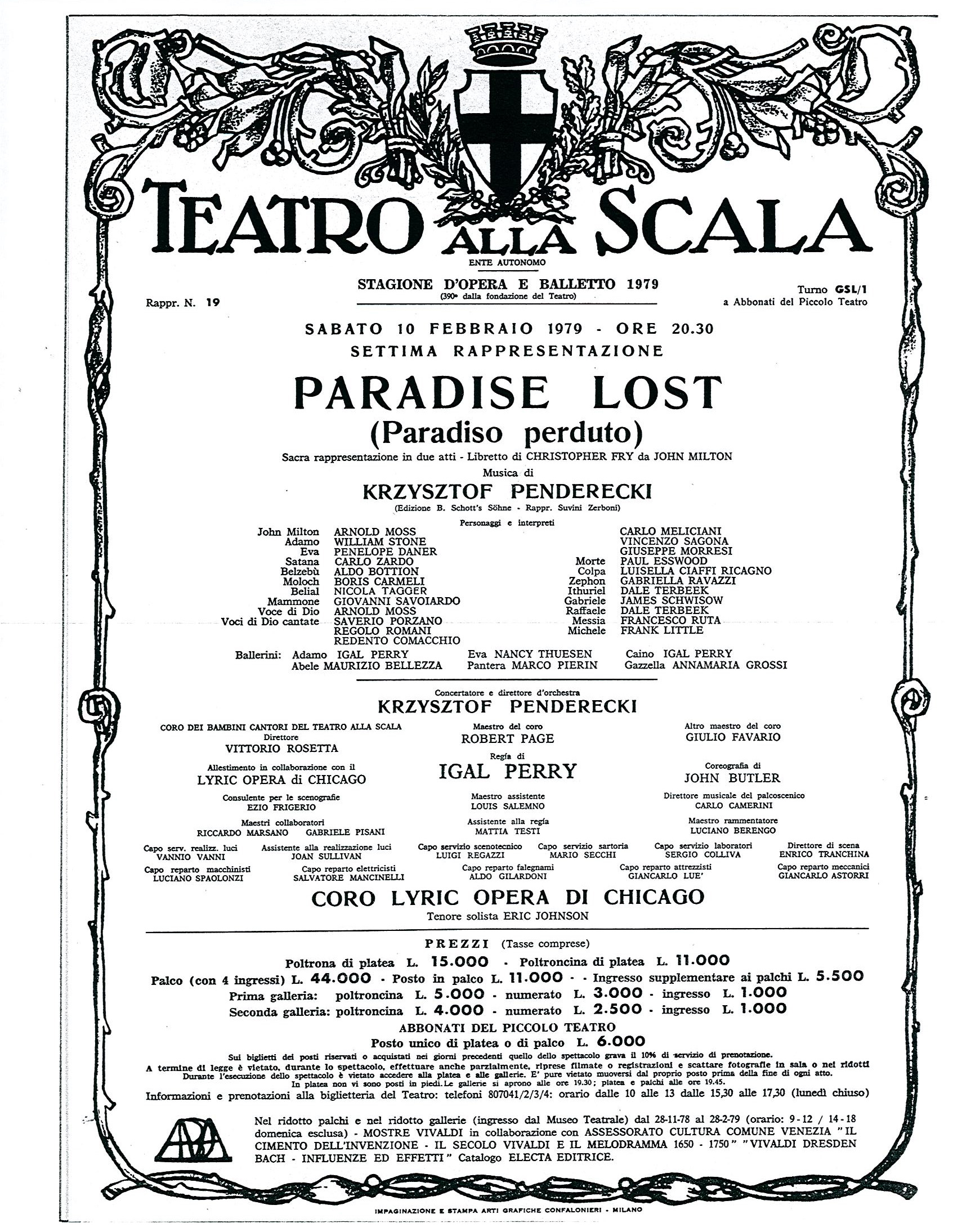
Poster of Paradise Lost performances at Teatro all Scala in Milan, 1979