

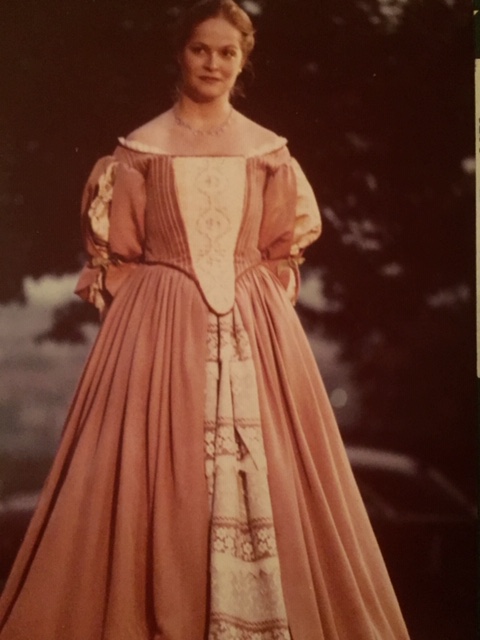


The question every acting student asks is how did you get a career started? What did you do? In my acting lIfestory that I wrote, the Baltimore section is mostly about my pre-professional days. I decided to add it in here to begin to suggest answers to those questions- “After you left school what did you do?”, “What were the steps you took to get started?” My college career shamefully had not provided me with any information about how to get into the industry. I was deeply lost. I was too afraid to go to New York without any knowledge of what to do. Same for LA. I had no instruction on what to expect if I went to those cities, what kind of career I might be facing in NY vrs LA. It was a deep scary mystery. I certainly did not want to go alone. I had a new boyfriend and he was moving to Baltimore, his hometown. So I went with him. The newspaper my boyfriend worked at had lost their receptionist. So I applied and got the job. I also did the layout for the small advertising pages. So the necessities were now taken care of. I had a safe home, and I had a job bringing in enough money to pay rent and groceries. The next step was to figure out how to become an actor. This story below will not be your journey. So much has changed. But it might offer some insight into a process, the work needed. I think it is good to just get out there and begin to act. See what you’re like in the marketplace. Especially if you’re thinking about it as a career, or before you plan to study at any graduate school.
The local newspapers at the time, (which unfortunately have become a thing of the past), would often have a theater section or an arts section. Often the smallest section the paper. But there was a Jewish newspaper in Baltimore that had a huge section on the Arts. It always had auditions listed for all the local theaters. Not for the one Equity professional theater, but all the rest. And there were a lot of them. I would drive around to take a look at all these theaters. See if they were in areas of town I felt comfortable in, see what kind of plays that they were doing. I was trying to find theaters that most seemed to match me. I started to try out for shows, and the first couple auditions I did, I got cast immediately in their productions. I realized fairly quickly that I was a marketable commodity. Somewhat to my surprise.
That first summer and fall I was cast in three productions. One was a good pre-professional theater called The Cockpit in Court. They did mostly summer stock shows and musicals, but also Shakespeare. So, they had a good long rehearsal period. Not this ‘two weeks and you’re on’ awful nonsense. (Shame on theatres that do this). I was cast as Anne in “Butley”. Just the kind of role I needed at that time. I really only had one big scene, so it was not demanding. But the character was talked about all through the play. It felt as if I were in most of the scenes. When Anne finally comes on, she has this one delicious battle scene with her husband. Then you’re off. It was a good starter play for me because I had no fear. I imagined another actor starting off at a young age, taking on too hard a play, and being frightened by it. It might turn you away at some point from the craft.
The next production almost did that for me. I was cast as Lady Bracknell in the “Importance Of Being Earnest”. I was 24 years old. Somehow I had beaten out all the older ladies that had tried out for the part. I don’t know what that Director saw in this 24-year-old kid that made him think I could do this battle-ax Lady Bracknell. But somehow I pulled it off. We performed in a huge auditorium. So there were large audiences to see these shows. I don’t remember much about the audience. I mostly remember trying to become this character in only – yes- that “two week and you are on” time frame. This kind of rehearsal really does nothing for the actor and is a disservice to the play. You barely have time to learn lines and blocking, then your are on. You have no time to get the character and words into your bones, so you can relax and handle situations that might come up. And they always do in live theatre. Let alone plumb any depth the play might be asking for (hopefully). I had no concept then as a kid, that when you become a professional you’re more likely to play a character closer to who you are, rather than have to transform so greatly outside of yourself. I was young, and still a student of the craft, and the biz. I had those silly college make-up stippling classes in mind. I thought maybe this was normal, to play an old person at age 24. Anyway… there was one night that I’ve never forgotten. Lady Bracknell refers to many women of her acquaintance in the play. Somehow on this night the first lady I started to mention I couldn’t remember her correct name. So I inserted another lady that I knew from the text. And then when it came time to say that lady’s name, I had to change it to another lady’s name. The entire evening was about trying to remember which name I had referenced earlier and keep the stories straight. I don’t remember being frightened by it at the time but just being- I don’t know- discombobulated. (What an interesting word that is). Instead of playing the character, and going through her story, a secondary story was being played, Wendy trying to catch up with herself all night. It was not comfortable. Afterwards, I was scared that it could happen again. That fear then unnerved me for the final shows. Luckily all went well. It was a learning curve for me, to tackle that discomfort.
The third production I did during that same time frame was “A Doll’s House”. I played Mrs. Linde. This production was done at Theater Hopkins and the woman that ran the place, Lauralene, was a treasure. Again, it wasn’t a large role, but it was larger than Anne in “Butley”. We had time to adequately rehearse. I remember beginning to do more research for my roles. I remember thinking at the time that I was beginning to get a better understanding of how to do this acting thing. I prefer to play characters who have some fight they need to battle out. Seeking Justice over Injustice. Mrs. Linde was a single woman in a male dominated society that didn’t value women and the work they could do. (When did they ever?) She was a working woman at a time when women did not usually work in businesses. She was alone. She’d lost the love of her life. Now he was coming back into her world. If she took him back, she would also take on his mistakes from his past. So, she’s smart, capable, but in a society that works against her. She needs help. She has few friends. The stakes are raised for her. Having time to rehearse and do the research, understanding the complexity of the character, made me understand more clearly what to fight for and how dramatic these choices were in her life. As I used to say to my students “Raise the Stakes. It’s drama after all”.
Another lesson I learned during that show was that sometimes you get cast opposite an actor that you don’t like, for whatever reason, or maybe for no good reason. You just have an adverse reaction to them. And you’re stuck having to do love scenes with them. So here you are trying to become this other person, to feel what they feel, live their life, but you personally don’t like the man that your character is in love with. Sometimes you just can’t fully inhabit another person’s skin. So you end up having to ‘act it’, not ‘be it’. I remember it was very hard for me to get my own dislike of this person out of my performance. There was no good reason for it. Probably he was perfectly nice guy.
——
II
So it went on like this for several years. Auditioning for anything I felt I was right for. I was cast in many shows a year. Of course in amateur, or pre-professional theatre there is no money. You have to hold down a real job. But, it was good training. Though some theaters you go to work in would have very bad community theater habits. You had to be aware of that and monitor yourself. Learn what these are and how to avoid them. Some directors would say learn your lines and blocking and that’s all you have to do. I knew that wasn’t the truth, certainly not what made good theater. It was only years later that I understood why. There needs to be a personal connection between you and your character as you go after what your character wants. And the more deeply you understand it, the more you can open up that story to the audience. They will feel you fighting for something, they will understand your pain, or pleasure, more deeply. Some actors do this intuitively, while some have to really study and learn how to connect themselves. When a Director says learn your lines before first rehearsal, walk away. I know you won’t walk away, because you want the job, you want the income. But if you have any choice in the matter, walk away. I’ve had really good directors, who themselves are actors, who know the process, who still might say this to an actor. No-no. Learning your lines before hand is different from studying the script so much that you almost know your lines before hand. Those are two very different things. In your career you will work with people who learn their lines beforehand. And then they find it very difficult to make choices later on in rehearsal because they have this image of what the lines mean that’s been made up in their mind before rehearsal. Then they hear fellow actors deliver the lines to them in a way that is different than what they imagined. Instead of listening to that difference and responding truthfully back to the other actor, they might get stuck in those line readings. If you can just hear the text, those lines, from your fellow actor the first time with no judgement, no preconceived notion of them, you might respond very differently. Any good actor will tell you 50% of the work is just listening. (Directors say the other 50% is good casting.)
I did walk away once, when a director showed me a script, saying it had 383 laughs (or some such number) in it and we would get them all. I turned it down. How can you know what your actors can and can not do before they start.
———
III
When my boyfriend got a job doing publicity for the Baltimore Opera Company, I ended up becoming one of their supernumeraries. Meaning I was an actor on the stage but I was not allowed to sing or even mouth the music. There was a union for the singers, and this was their rule. I was only allowed to act. The first show that I did, “La Traviata”, I was to play a handmaiden for the star, who was a very overweight opera diva. She took one look at me in first rehearsal and told the Director to put me in a nun’s costume. Any of the young thin women were immediately put into large nun’s costumes. Opera is done very differently from theater, or it was then. There was no real “rehearsal”. There’s maybe one or two days where you get to know the cast and you are blocked immediately on stage. The opera singers come in knowing their songs and their script. Then maybe on the third day the orchestra is called in and you put it all together. It’s the antithesis of what I just said good theatre is all about. You can feel the opera stars doing their own solo show , and it’s harder to get them to actually connect to each other. I was playing Manuelita in “Carmen”. She is the woman Carmen has the fight with in the beginning of the opera. The Director wanted us to come out from the factory (that the script says we are working in), already fighting. He asked if we could smash fruit into one another faces. A real catfight. The opera diva playing Carmen, who was probably around 50, ‘squashed’ that idea immediately. She said she would come out from the other side of the stage, being carried on the shoulders of the men in the cast, while the women came out from the factory on the opposite side. Why Carmen was over there and why she was on the shoulders of the men made no sense, but it seemed a grand way to enter to her. Then she directed that she would take one look at me and I would then run off screaming. End of fight. Did she have lasers in her eyes? Again, it made no sense, but then maybe people don’t go to the opera for an actor’s truth, they go to hear the singing.
——————
IV
As I said earlier, none of this made me any money. Then the newspaper we were working at closed. I had to find another job. This was before Ronald Reagan got into office and began the destruction of America, certainly of the middle class, and definitely of the Arts in America. There was something called CETA. The Comprehensive Employment and Training Act. This was a federally-funded artists employment project. The largest since the arts programs of the WPA in the 1930s. It was a government program that helped pay some of the full time salaries for workers in arts institutions. I was lucky to have gotten one of those jobs. I worked as an assistant to the Director of the Theater Project in Baltimore. It was there, in this mostly touring house for independent and international theater projects that I learned a whole different way to make theater. Instead of the proscenium house where actors are hired, learn their lines and blocking while someone directs them, here there were – theater collectives, individual artists doing solo shows, experimental theater that used lots of technology. I learned there’s a myriad of ways to tell and devise “The Story”. Philip Arnoult ran the place, and he was one of a handful of people in the United States over many years responsible for creating a network of international theater connections. The Theater Project applied for and was given a lot of National Endowment for the Arts and National Endowment for the Humanities grants. With these grants there were two projects that I want to share that were so successful. One of them, “Baltimore Voices”, was created out of oral histories taken from individuals living in Southeast Baltimore. These stories were then put into a performance format. The resulting play was so successful in the community that it was also filmed for PBS. This was before Anna Deveare Smith began her very successful oral history performances. The other project which I think was my favorite, was called “The Rat Squad”. The city of Baltimore had a rat problem. They were looking for ways to try to help mitigate that problem. They wanted to educate schoolchildren on how they could help in their neighborhoods. So information was gathered about how communities could help control their rat population. Then this information was put into a play. There was the main character- Dr. Rat, and his Squad, who toured all the Baltimore city schools with this fun interactive project that told kids what to do in their neighborhoods. It taught them about the devastating effects of littering and throwing food on the streets. If they saw trash gathering on the street corners, or someone had thrown an old refrigerator out on the street, it told them where to call to get it cleaned up. Dr. Rat, during that time, became as big as Ronald McDonald in the city of Baltimore. I think he may have even thrown a baseball out at an Orioles game. I was learning that theater had many forms, and many uses. And that, like- fresh water, food, & shelter- “The Story” is an essential part of life.
———
V
After the CETA program ended at the Theatre Project I was able to get a real paying acting job. Doing children’s theatre, performing in many of the cities schools. It was not ideal. We had to carry big heavy set pieces and set them up at 7 or 8 o’clock in the morning. Then we’d perform “Pinocchio”, where I played both the Blue Fairy and the Big Bad Wolf. It was a little humbling, but it was my first real paying theatre acting job. Playing for children felt safe. I was in a community of actors. I had a paycheck, I was acting. It might not have been Hedda Gabler, but it was in the theater.
———
VI
I knew by now some things I had to do in order to get real professional acting work. I had to begin to find and memorize more monologues that were appropriate for me, that highlighted me and my skill set. It meant reading a lot more plays and choosing appropriate pieces to work on. I then hired a woman who had just graduated from Yale drama school, who was in Baltimore directing at the time, to work with me to perfect these monologues. When I had about a dozen pieces more or less prepared, I started looking into summer Shakespeare work. One of the places I applied to was called URTA. Some of the summer Shakespeare companies were auditioning through them in their spring auditions. I only understood that URTA was a place that Shakespeare theatre companies came to cast their shows, I did not even pay attention to what it stood for. University Resident Theater Association. I had no idea this was a graduate school cattle-call essentially. I passed the local rounds of auditions that were held in DC at Arena Stage. On the train back to Baltimore I sat with some people from the event, and a young man told me that the main judge of the local DC competition had said to him there was only one person there that day worth seeing. And “she” had done a piece about Queen Christina. Well… wow.. That was me! I had done a piece from “The Abdication”. Thank you Ruth Wolffe for your amazing plays, (which unfortunately actors rarely get to read or see these days). After that it was on to the NYC auditions. A little frightening. After doing my “2 contrasting pieces” , in my long home-sewn caftan gown to appear “Shakespearean”, I was handed a long list of names that wanted to meet me. Longer than almost anyone else’s list that I could see. It turned out there were a lot of schools on that list. Schools? I did not want schools. I wanted a job! There were a couple Shakespeare theatres as well. I met with everyone. I entertained for the first time the idea of going back to college. Many offered me large financial packages. But most were still going to cost me in the end, and I knew enough by now, having been in the marketplace, that an actor earns little money and can not pay big debts, unless maybe they go into film and become very successful. I still had no connections in The Biz. I just knew I wanted to do stage work. The catch-22 of becoming an Equity professional actor is you can’t work in an Equity house unless you are a member of Equity’s union, and you cannot become a member of the union unless you work in an Equity house. It is a hard nut to crack open. Though I had no intention of going to college, after talking to a lot of these schools, I found I was really attracted to the offer from the Playmakers Repertory Theatre program at UNC-Chapel Hill. They had offered me work as a professional Equity actor, giving us our union card, as well as being paid to teach undergrads! Acting training. And my MFA degree, that is required to be able to teach if you chose to go the route. That sounded like three years of being on stage and being paid. They would turn me Equity! That was all I wanted.
VII Graduate School
First- let me suggest that if the school you plan to attend does not pay your way to train as an actor, or at least makes it so you have very little debt at the end… go somewhere else. You can not be an actor and have a big debt. Unless you become an major player in the film world, or have rich parents… you will not be able to pay it off. Especially if you are a theatre actor. Take time off before going from college to grad school. Get some financial literacy. Find yourself in the marketplace and make sure this is what you want for your life.
I enrolled for my MFA, moved to Chapel Hill, NC, and began to work for Playmakers Repertory Company. A director named David Rotenberg, and another named Gregory Boyd ran the program my first year. David left after that first year and then Greg ran the program hiring a lot of his friends and his wife at the time. I didn’t always understand why and how Greg made his choices. He was a difficult man. I needed more transparency, and more caring. I knew he liked me as an actor, a lot. I knew he thought I was talented, but they kept giving me these student reports that said that I somehow wasn’t learning what they wanted to teach me, even though they said that I was probably the most talented actress there. Guest teachers would come in and they would write reports saying just the opposite. They would say in response to Greg that some of the training was not clear to me because it wasn’t helping me go down the acting path that I already understood inherently so well. They said they needed to just support my own path, because clearly I was on one. Grades weren’t important to me, it was the work that was important, and I’d always gotten fairly good grades anyway in my life. I had another visiting professor write to the head of my program that he felt that ‘Wendy already had an instinctive understanding of the business and that sometimes what people were trying to teach her would go against her instincts. While the teacher may think that she is not willing to learn, her instincts should be encouraged, instead’. I believe the three years that I spent acting before I went into grad school probably gave me a lot of those ‘instincts’ he was talking about.
Looking back, the work we did at that time was some of the best work I’ve been in, or I’ve ever seen. Yes, I was young, it was new to me at the time, but it was vital and exciting. For as difficult a man as Greg was, he loved theater, he loved Actors, and he loved you when you did it well, which meant onstage it was a fairly safe place for me. He would yell and scream at technical people, yell and scream if you were doing it badly, but when you rose to the occasion as I usually did, he appreciated it. He acted himself as well, so he knew the strain of it. Greg became a big player in theater world later when he took over the Alley Theatre in Houston, until his demise during the #metoo movement. David became one of Canada’s best known acting teachers, founder and artistic director of the Professional Actors Lab.
At graduation, I had $7500 in school debt, and I paid off $2500 right away. That remaining $5000 took me 10 years to pay off and it was $9800 I had paid back in the end, after additional interest was applied. The final payment was made by cashing out a small life insurance policy I had gotten when working at the Theatre Project. I think it paid back about $600 after 12 years of paying into it. But my school loan was done. Do not take out large loans if you want to be an actor. I will say to any Actor getting ready to get into this industry – under no circumstances ever, ever go to a school where you were going to have a huge debt that you cannot pay back. Even a medium size debt, you will not be able to pay back. A small one, maybe. If you’re serious about becoming an actor, in particular a Stage Actor you have to keep your spending down. You have to learn to do without a lot of things. It’s gonna be hard enough just to pay for rent, utility bills, doctor bills, and trying to keep yourself in “nice enough” clothes that you look presentable in. One other lesson that I’ve learned over the years, is that if you have a ‘back-up’ plan, which everyone will tell you to have, you will probably end up doing that back-up plan instead of acting. If there’s absolutely nothing else that you want to do besides this theater business, somehow you will find a way. You have to persevere. Do the work. Face the fear and discomfort. Write those letters, take those meetings, learn who runs the theaters. Learn who casts for which theatres. These are important lessons.
At UNC I was very fortunate to be on the main stages from my first year through my graduation. If you go to a school that doesn’t allow you to be on main stage but keeps you in a classroom, leave. I’m reminded when my father asked me if I wanted to learn to fly our airplane, I said yes!! Age 15. Then he handed me a couple books and said read and learn these, and then I will train you. Needless to say my reading those books, or attempting to, weren’t making any sense without some kind of hands on experience. I knew more about flying from just sitting in the passenger seat with him than I ever did from looking at those books. Working on those stages is where you learn your craft, and about audiences. Most of the classroom stuff was waste of time. Except for the creation of better monologues for yourself, because you’ll need them to get into the industry. And I suppose scene work was valuable as it gave you the opportunity to work and watch a large variety of different authors and begin to understand how to adapt styles. Whether you’re doing a Tennessee Williams, Oscar Wilde, or a Fugard play, you need to understand how to play in these different environments.
I do want to mention the best teacher I ever had. Cicely Berry. She was the vocal coach at the Royal Shakespeare Company. She would come once a year to train us. She trained the voice using some vocal work exercises, but more often she used dense rich language material to work on, Shakespeare of course, Marlowe, Edward Bond, and many poets. We learned how to use our voice by tackling this material. In the work we learned how better to deepen our connection to the language, to find a words deep meaning inside us and bring it forth. She was marvelous, tough, funny and so caring. I was traveling in England once and was on my way to visit her at her lovely home. I was in Edinburgh watching a play about the first Americans to record a Russian opera singer. I stayed after to talk to the actors because one of them had nailed the American accent. Turned out he was an American. He then asked me what I did, was I a “nurse”? A nurse? Where did he get that idea from? I was offended, and my inner cat reared its head. I said, calmly and controlled, “No I am an actor”. He was not terribly wowed. But then I shared with him that I was off to stay with my friend Cicely Berry. Finally, he was impressed.
I want to mention one other place I learned about acting. It was in Stratford, Ontario that I discovered an actress who became my mentor, though she never knew it. Martha Henry. I aspired to be like her when I became a professional. I carried around a photo of her to every show I ever played in, as a reminder of the type of actor I wanted to be. Powerful, effective, moving, empathetic with a will to really tell her character’s story. I got a lot of my actor training watching those Stratford actors transform every summer. I learned that there are some actors like the late Nicholas Pennell who can become/transform into so many different people. Each season he changed so often. Then there were other actors that more often played different versions of themselves, like Maggie Smith, or Brian Bedford. It was going to be my job to figure out who I was. An actor who says ‘look at me’… or one who says ‘listen to my character’s story’. I wanted theatre to allow me to inhabit other people, become someone other than myself, and to move people into learning something new about themselves. I also wanted to be part of a company of Actors that worked with each other time after time.
——

