

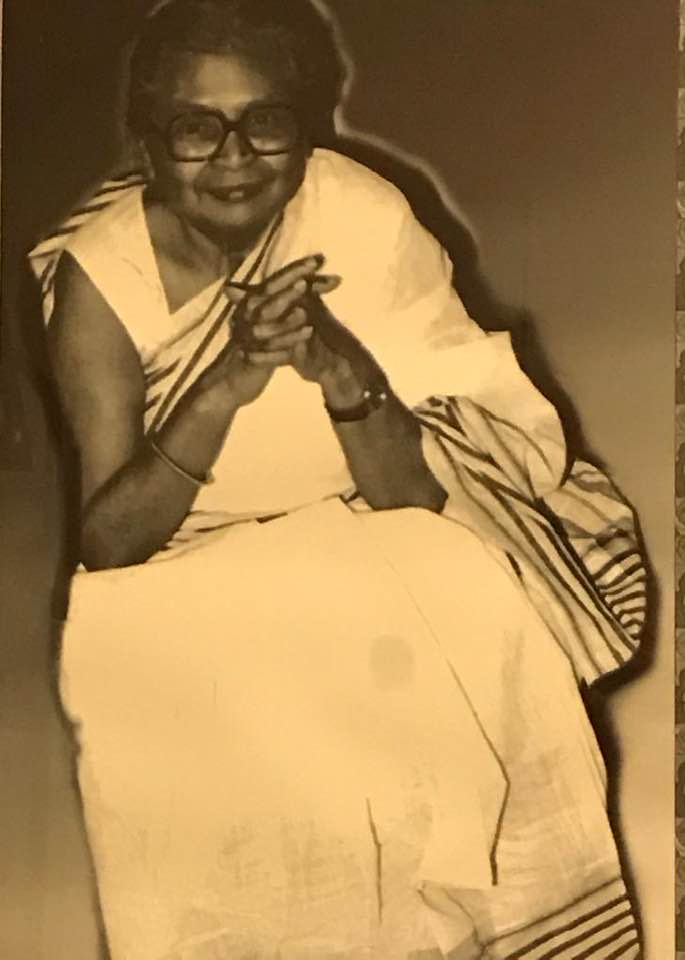
My mother, Anjali Roy Chowdhury, a dedicated teacher of English, has been a constant source of inspiration throughout my life. Balancing a full-time job while nurturing and raising four daughters was a remarkable feat in itself. Her commitment to both her profession and her family was unwavering. What made her even more extraordinary was her passion for the arts. She played the piano with grace and eloquence, filling our home with beautiful melodies. Yet, it was her nightly recitations of poems by luminaries like Shelley and Wordsworth that left an indelible mark on me. As a high-energy tomboy, I always preferred to remain physically active, but there was a magical quality in the way my mother breathed life into those verses. It calmed my mind and powered my imagination. Her voice had the power to transform a restless spirit into a calm, contemplative one. My mother’s ability to blend the worlds of education, art, and motherhood has been a life-long lesson in how to realize the transformative power of the arts over and over again.
In addition to my inspiring mother, my uncle, Akshay Roy Chowdhury, played a pivotal role in shaping my artistic inclinations. He was a live theater actor who enthralled audiences with his performances in plays and musicals. His ability to infuse every scene with boundless energy and passion was a true marvel. I was fortunate to be his unofficial student, and under his guidance, I learned about the art of acting. Whether it was a dramatic monologue or a lively musical number, he taught me how to convey emotions and stories with authenticity and vigor. Beyond the stage, my uncle was also a masterful orator of Bengali poems. I would often watch him with awe, feeling inspired to join in on the recitations. He spotted my talents early and approached my parents, urging them to nurture my passion for drama and dance. However, it was the 1950s, and the idea of a girl pursuing performing arts was considered somewhat unconventional, even taboo in certain contexts. But fortunately, the seeds of artistic expression had been sown, thanks to my uncle’s encouragement and my mother’s unwavering support. Their influence continues to resonate in my life, reminding me of the importance of breaking societal norms to pursue one’s passion as well as stepping into one’s purpose with energy, empathy and confidence.

During my adolescent years, when my mischievous nature seemed irrepressible and my passion for the performing arts continued to blossom, my parents made a challenging yet pivotal decision: they sent me to a boarding school, Vishwa Bharati, nestled in the serene surroundings of Shantiniketan, India. This extraordinary institution was none other than the creation of the great poet laureate, Rabindranath Tagore. Shantiniketan was a school amidst nature, where towering trees and lush greens were our constant companions. Some of our classes were even held outdoors, beneath the expansive canopies of ancient trees. Here, we were encouraged to roam freely, sing aloud, and explore our artistic talents, all while exemplifying the idea that when children are given autonomy and tools, they create a full, balanced, and vibrant life. What set this school apart was its unwavering commitment to the arts. Training in various dance forms and vocal performances were mandatory aspects of the curriculum, and athletics and STEM classes were non-negotiables. However, what truly allowed Shantiniketan’s unique spirit to shine was its approach to discipline. When a student’s mischief was detected, the punishment meted out was gentle and constructive, fostering personal growth through introspection rather than instilling fear. It was in this idyllic setting that I found the self-reliance and inspiration to create movements that told stories through body language, acting, and even recitations of poems that would ultimately lead to musical performances. My time at Vishwa Bharati left an indelible mark on my artistic journey, shaping me into the teacher, performer and storyteller I am today.

Recognizing my early interest in dancing, my mother took a significant step to nurture my passion by enrolling me in Kathak, a North-Indian classical dance, at a young age. Kathak is renowned for its graceful footwork and intricate hand movements, and it involves the use of “ghungroos,” a roped chain of small bells tied above the ankles to create enchanting rhythms. What particularly fascinated me about Kathak were the swift spinning turns, rooted in Sufi spirituality and Bhakti era devotion, which added a mesmerizing dimension to the dance. Even when I was sent to Shantiniketan, I continued my Kathak lessons during breaks at home in Kolkata. Slowly but steadily, under the guidance of my remarkable guru, Bela Arnab, I became well-versed in the art of Kathak. And my journey did not stop there. I sought additional lessons from the renowned Amala Shankar of the Uday Shankar Cultural Center. In this setting, the emphasis shifted toward exploring how various movements from different South Asian dance forms interact with each other, broadening my horizons as a dancer and allowing me to see dance in different contexts. The steady stream of guidance I received from my gurus, Bela Arnab and Amala Shankar, have been instrumental in shaping my enduring passion for storytelling through movement and continue to resonate in my artistic journey, reminding me of the profound impact that dedicated mentors can have on one’s life.

