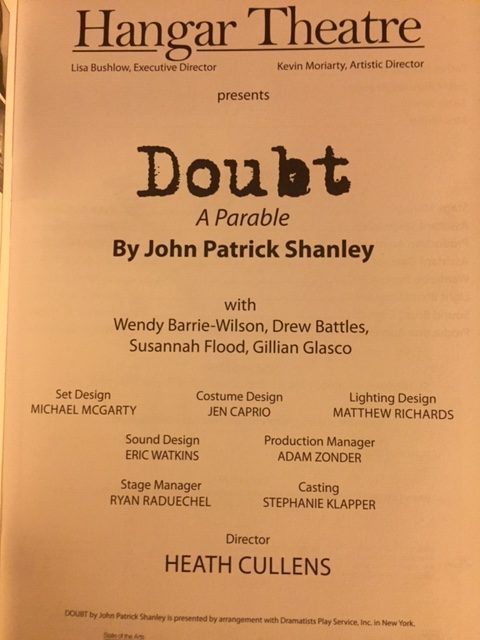
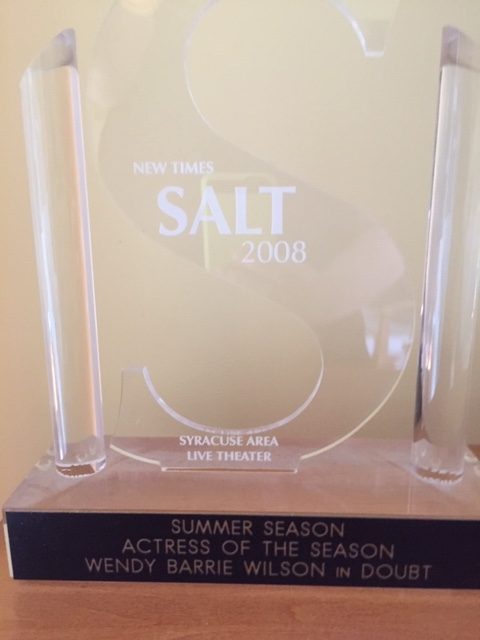
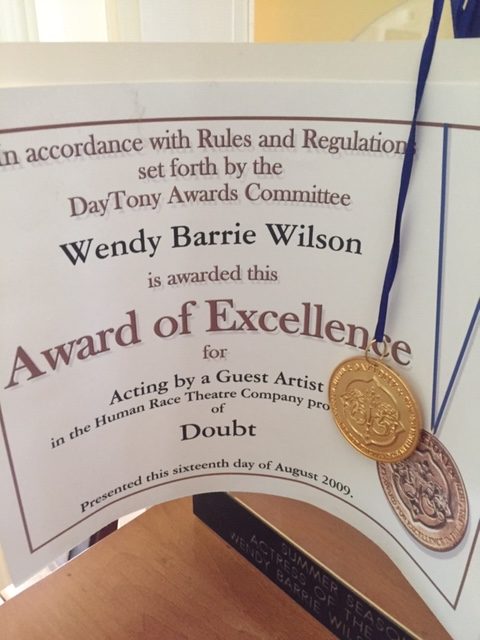
I had the good fortune of playing Sister Aloysius in John Patrick Shanley’s play DOUBT several times. First, in the European premiere at Vienna’s English Theater; then, in the first rights production in the States, at the Hanger Theater, in Ithaca NY, where I won the SALT award (Syracuse area theater) for Best Actress of the Season; and later, at the Human Race Theater in Dayton, Ohio, where I won the DAYTONY award for Best Actress.
I want to share a lesson in doing research on a part, and why it is so important. When I read “Doubt”, I really did not like Sister Aloysius. When I was offered the role I knew I’d have to do a lot to try to understand this character. As I said before I really disliked her and what she stood for. I began to do my research. I needed to understand what her life was like in this religious order. I had to understand the Catholic Church during this timeframe. I had to understand what it meant to go from Vatican I to Vatican II. How did she become who she is in this play? Where did these ideas she had come from? I took all the clues that were in the play (“The Givens”- facts) and added them to all the research I was doing. Then I begin to define for myself what her past biography might be.
There were certain things I learned that were important to me in playing her. First, she knew men. She’d had a husband who died in the war. So I had to make some decision about her feelings about this husband. It seemed to me that she had married at a normal young age and then he had died doing service for his country. She had no children. So I decided that after his death, instead of marrying somebody else, she felt she wanted to honor him by providing a service herself. The way she chose to do that was to enter the church, give herself to God. Do good works. She talks a lot about ‘knowing people’. And it’s not in a good way that she ‘knows people’. She seen how awful people can be. I assumed some of these people she knew were the priests she had run into who were pedophiles, and the church’s way of handling these matters over the many years of her service. The play clearly states that if the Monsignor doesn’t believe the story about the Priest, then it is suppressed. Then maybe they are moved and given a new better position. It’s also very clear that she has very few friends. Her one good friend is going blind. I came to believe that she understands her job to be the one who frightens the children into compliance. More Vatican I than Vatican II behavior. She has been taught that this is the way to handle these Catholic children. ‘Spare the rod spoil the child’ philosophy. Her following these instructions the church and her community have given her has caused her to be not liked and very alone. I think she has made her peace with it. Somebody has to do it, protect these children, and she has the strength to undertake it. The only thing Shanley shared with our Vienna cast, (via our director) was the question – “Where were the nuns when all this pedophilia was going on?” And he does dedicate the play to the teachers/nuns he grew up with.
By the time we had opened the show, instead of hating this character, I completely understood why she did what she did. In order to understand it, I had to walk in her shoes, I had to understand the precepts of her practice. I had to better understand the church and her function within the church. It became very clear that she had no other choice. She saw herself as a strong enough character who could/would have to handle this matter herself because she knew the church priests in power above her would not deal with it. Even though she wasn’t absolutely positive about whether he was guilty, that this Priest might be a pedophile, it’s better to get him out of her church than to risk him damaging the children in her school. She knew the Priest would just be promoted somewhere else. So if he was innocent he’d be fine. If he was guilty, her greatest concern was that she was passing off the problem to somebody else less capable, maybe, than she of handling it in their school. At the end of the play when she says “I have doubts”, for me it’s not that she has doubts about what she did to this Father, but that she has doubts about the church. She has doubts about what will happen in the next community if he is guilty. She has doubts about the way these priests are handling these situation’s. She has doubts about the rules that caused her to become this person under the old church doctrines, and the changing rules, especially now that Vatican II was making everybody lighten up, be more friendly. Be more caring. What would she have been like had she come up in the Vatican II church? Who would she have become. And what is gonna happen to all of these children as they grow up having been violated in these spaces? My work on this production more than any other play reinforced why doing enough research is needed to be able to walk in another’s shoes. It taught me that empathy is something that we need to constantly be working at and developing.